Ads Are Now Part of AI Conversations. Nonprofits Should Pay Attention.

By Vijay Malavia, Director of Digital Media, Streetlight Digital

At this year’s Google Marketing Live, Google introduced Conversational Discovery ads and Highlighted Answers. Google is turning advertising into guidance, and it matters for nonprofits. This is the third post in our series on Google's biggest search change in 25 years.

What, How, I, Is, Can are the top first words in AI Mode queries. Google's new report says, "the average AI Mode search query is triple the length of a traditional search query." These are the question-form queries Post 1's intelligent search box is engineering. AI-powered query suggestions push users to longer, more nuanced searches.

Per Google: "your ad answers a person's specific question." These ads appear from campaigns using AI-powered targeting: AI Max, PMax, or Search with Broad Match plus Smart Bidding. Exact and phrase match-only campaigns are excluded. AI Max (Google's AI-powered Search campaign type) is the most aggressive of these: it auto-enables search term matching and text customization, where Gemini generates creative on the fly.

Here's an AI Mode query: "How can I raise funds for an ALS charity this summer/fall." AI Mode pulls from 11 nonprofit sources including the ALS Association and Les Turner ALS Foundation. The ALS Association's "Walk for a World Without ALS" appears as a Sponsored ad in AI Mode: "To get started with your own fundraising team, you can register for an event like this one."

Similar to traditional search ads, these ads blend in with the organic citations: same card format, image placement, icon styling. Only the "Sponsored" label distinguishes it.

With text customization on, Gemini reads your landing page, existing ads, and search intent to generate creative in real time. Your mission, event, and program pages tell Gemini what to write. That's a show stopper for most nonprofit accounts. Medical research, veterans, advocacy, donor copy need legal review.

Google has built controls in AI Max: AI Brief for plain-English guardrails ("never use cure"), and Mandatory URL Disclaimers that lock legal language even when AI expands the landing page. The question for nonprofits is no longer whether to implement AI Max but how aggressively, and with what controls.

With a billion monthly active users and queries doubling every quarter, Google is creeping towards AI Mode as the default search experience. Monetization is the key that unlocks the gate. These ad formats are how Google figures it out before flipping the switch. OpenAI opened ChatGPT ads to all US advertisers on May 5; Google announced these formats 15 days later. When a competitor closes in, a Google product follows. Same as it ever was.

A few things we will be watching will be whether connected apps data (the layer behind Personal Intelligence) becomes an ad matching input alongside location and audience targeting. Ad Grants run in a secondary auction after paid Search clears. Whether AI Mode inventory follows that structure, or whether Ad Grants are eligible at all, isn't documented. And whether advertisers will see AI Mode performance broken out from traditional Search in reporting.

Search Just Got Personal: The New Rules of Nonprofit Visibility

By Vijay Malavia, Director of Digital Media, Streetlight Digital

Last week at I/O, Google also expanded Personal Intelligence in AI Mode. In layman's terms, this is a shift away from generic AI answers to ones tailored specifically to you. The feature personalizes responses with context from Gmail, Photos, and soon Calendar. Ask AI Mode to plan a getaway and it can draw on your hotel confirmations and past trips. Instead of answering questions based only on the web, it blends public information with your personal context.

When applying this to nonprofit research, the new AI-powered query suggestions (covered in our previous post, Google's Biggest Search Change in 25 Years) encourage supporters to ask more nuanced questions: discovering causes, comparing orgs, vetting impact. Those answers now draw on what's in their inbox. Spooky? You tell us! But not surprising, if you've been following Google's trajectory along the way. This is a natural extension of a broader shift toward personalization powered by connected data.

The timeline for search transformation has been slowly but surely reaching this point. Let's explore the 2026 rollout.

January 22, 2026: Personal Intelligence launches in AI Mode for AI Pro and AI Ultra subscribers resulting in an early-access layer of deeply personalized AI search, testing how far users would go in trading data for convenience and relevance.

March 17, 2026: Expands to free-tier users in the Gemini app and Gemini in Chrome.

May 19, 2026: Goes global to nearly 200 countries and 98 languages, no subscription required, Calendar coming soon.

Why does this matter?

After all, search has always personalized based on what Google knows about you, but namely your location, search history, your device. Email content has never been one of those inputs, but Personal Intelligence changes that. The industry has been pushing first-party data for years as ad targeting eroded and privacy ate the cookie.

Personal Intelligence raises the stakes because visibility is no longer just about ranking on the open web, it’s also about being present in the user’s personal data footprint.

For nonprofits, this is a new kind of visibility. Ask AI Mode "which veterans org should I support for Memorial Day," or "which org is helping with the Ebola outbreak," and Personal Intelligence can lean on context from the supporter's inbox to inform the answer.

Simply being surfaced does not mean you will be chosen, but it raises the odds. Visibility may produce a direct click in AI Mode, a branded search later, or direct traffic.

In direct response fundraising, lead generation is often the first thing cut when budgets tighten. Personal Intelligence makes that a riskier decision than it used to be. Because now, those earlier touchpoints (email subscriptions, small donations, content downloads) don’t just drive immediate ROI. They also seed the data layer that may influence future discovery inside AI-driven search.

This is a critical conversation for nonprofits planning out their budgets and we need to keep the conversation going. Stay tuned for what's up next: ads in AI mode.

Google’s Biggest Search Change in 25 Years: What It Means for Nonprofits

The shift from search to real-time intelligence: AI agents continuously scanning and synthesizing information across the web.

By Vijay Malavia, Director of Digital Media at Streetlight Digital

On 5/19, Google announced three changes to Search at I/O, all under the new intelligent Search box. The first major change to the search box in over 25 years. How does this impact nonprofits? Some help, some accelerate challenges already negatively affecting your website traffic, some leave open questions.

Let’s start with the good: Google’s information agents (rolling out Summer 2026) take Google Alerts to a new level. Where Alerts emailed keyword matches, agents monitor the web 24/7 and message you the instant something changes, with a synthesized summary of what happened and why it matters. In Google’s framing, the agent will “intelligently look across everything on the web, like blogs, news sites and social posts, plus our freshest data”. Here are a couple examples where this could play out in a legitimately helpful way for nonprofits:

Health: an agent watching FDA approvals, journal publications, and conference announcements in your disease area, surfacing study design and patient implications so fundraising and advocacy can react before the news cycle moves on.

Gun reform: an agent watching mass shooting incidents, surprise court rulings, and retailer or manufacturer policy changes, surfacing facts and affected populations so creative and advocacy outreach can mobilize while attention peaks.

That’s the upside. But the same shift that makes these tools powerful also accelerates a trend nonprofits have been feeling for years: fewer clicks, less direct traffic, and more answers happening inside Google itself.

Google’s new AI-powered query suggestions go way beyond autocomplete. As Google described in its I/O announcement, the new Search experience is “more intuitive than ever, dynamically expanding to give you space to describe exactly what you need… designed to anticipate your intent.” Classic autocomplete runs on real user searches, language, location, and trending topics.

Whether the new AI-powered suggestions use the same foundation is unknown. The new suggestions also push users into longer queries that often resolve inside AI Mode without a click. Instead of returning a list of links, Search now drops users into AI-powered interactive experiences. Google also extended AI Mode integration so users can ask follow-up questions directly from AI Overviews and flow into conversational sessions. We've been watching this lead-up for sometime.

In January, Google added a “Show more” button in AI Overviews on mobile that dropped users into AI Mode. Then in April, we observed the same behavior tested on desktop. On April 16th, AI Mode on Chrome desktop started opening publisher links side-by-side with the AI panel instead of replacing it. When a user clicks your link inside AI Mode, they don’t leave Google’s interface. Your site opens on the right while AI Mode stays open on the left. Clearly, Google is moving in baby steps toward AI Mode as the default search experience. When does the switch happen? Likely when AI Mode monetization catches up to classic Search ad revenue, or when ChatGPT becomes a real enough threat to force the move.

We’ll continue this critical conversation in our next article, exploring how Google plans to monetize AI Mode, and what Conversational Discovery and Highlighted Answers signal for the future of nonprofit visibility and growth. Stay tuned.

Reading the 2026 M+R Benchmarks From the Trenches

👉 Read the full PDF.

The release of the 2026 M+R Benchmarks is one of our favorite days of the year. This year’s data shows 15% online revenue growth, with 37% of revenue arriving in December and 4% on December 31 alone.

But benchmarks don’t speak for themselves, especially in a year when teams are stretched thin and AI is reshaping how donors discover and decide.

Streetlight pulled together a clear, practical read of what the numbers are really saying, what we agree with, where the data needs context, and the planning risks we see ahead.

The Donor Participation Challenge: Why Nonprofits Must Rethink Donor Formation

When the spaces that once shaped generosity begin to empty, nonprofits must step in to create the “third spaces” where giving takes root.

Read the PDF

The Illusion of Stability: Fewer Donors, Bigger Gifts
Recent data shared in an Avid webinar reinforces trends Streetlight Digital has been watching for a while: fewer donors are giving, and those that remain are giving more. As broad-based participation declines, nonprofits have become increasingly dependent on mid-level and major donors. While this reliance has helped nonprofits maintain year-over-year revenue growth, Avid asserted that this bubble will eventually pop, citing declining retention rates among mid-level and major donors, as well as steeply declining upgrade rates among this donor group. 

The Missing Context: Declining Donor Formation
Streetlight sees these patterns, too, and while there are hopeful signals of growth (an uptick in new donor acquisition, for example), we can’t help but dig deeper. Are there underlying cultural shifts we need to pay attention to beyond channel trends and economic pressures? To really understand what is happening, we need to understand how donors are formed in the first place.

Historically, one of the most powerful engines of donor formation in the U.S. has been religious participation.

Data from Gallup shows that:

  • Church membership declined from ~70% in 1999 to 45% in 2023

  • Weekly or near-weekly attendance has dropped from ~40% in the early 2000s to closer to ~30% in recent years

At the same time, household charitable giving has steadily declined:

  • 2000: 66%

  • 2008: 61%

  • 2010: 53%

  • 2016: 51%

  • 2020: 47%

This is not a coincidence. For decades, churches functioned as more than places of worship. They provided habit-forming systems, such as weekly tithing, to cultivate giving norms. Churches and other religious institutions provided consistent fundraising channels and early donor education environments.

In short, they produced routine, habitual donors at scale. As attendance declines, that system is eroding. Fewer people are being asked to give regularly, socialized into generosity, or included in communities where giving is normalized. 

The impact may not show up all at once, but it may already be reflected in the data. Declining retention and falling upgrade rates among mid-level and major donors suggest a weakening foundation. And while an increase in new donors has boosted the pipeline, their long-term value remains uncertain if they haven’t been formed through consistent, habit-forming systems of giving.

A New Burden for Nonprofits, but Not Insurmountable

Nonprofits are now left with a new responsibility to actively shape donor behavior, as institutions like churches once did organically.

As religious identification declines, so too does one of the most consistent systems for forming habitual donors. At the same time, while online giving is often eclipsing offline channels in transaction volume, Streetlight’s position remains clear: offline engagement is not obsolete; it remains foundational, especially when shaping donor behavior.

The opportunity for nonprofits is not to replicate religious institutions, but to recreate the conditions that foster consistent generosity.

Rebuilding Belonging: Community as a Driver of Generosity
One of the most effective ways to do this is by cultivating a strong, community-driven identity. The most successful organizations today are building a sense of belonging among their supporters. In many ways, this mirrors what religious communities have long provided: a shared mission, a sense of connection, and a cultural expectation of generosity.

Offline touchpoints play a critical role here. Peer-to-peer events, especially those that are family-friendly, do more than drive revenue; they model philanthropic behavior. They introduce the next generation to giving, reinforce social norms, and weave nonprofits into the fabric of participants’ lives. Even if the final transaction happens online, these experiences are often what make the gift possible in the first place.

Creating Rituals: Turning Giving into Habit
A second opportunity lies in creating rituals of giving. Recurring donation programs and milestone-based campaigns provide structure and predictability, two elements essential for habit formation. Over time, these programs can normalize giving behavior, shifting it from a reactive decision to an integrated routine.

Contactability Over Attribution: Rethinking Measurement in a Multi-Channel World
Finally, nonprofits must prioritize consistent contactability across channels. Today’s donor journey is rarely linear, and channel attribution is increasingly difficult to measure with precision. Rather than over-indexing on where a gift occurs, organizations should focus on ensuring they are present across multiple touchpoints, such as direct mail, events, email, SMS, and digital platforms.

While this approach may look very different from the traditional act of passing a collection basket, the underlying principle remains the same. Providing repeated, accessible opportunities to give can reinforce behavior over time. In a fragmented, digital-first environment, it is the combination of these touchpoints that ultimately converts into a gift and, more importantly, reinforces the behaviors that lead to long-term donor loyalty. The organizations that succeed will be those that don’t just capture donations, but intentionally cultivate donors and actively shape the norms and habits that sustain long-term giving. 

Sources

Streetlight Digital Named Google Ads Premier Partner

We’re thrilled to share big news!

Streetlight Digital was recently recognized as a 2026 Google Ads Premier Partner, placing us among the top 3% of Google Partners globally. This honor reflects not just our expertise in Google Ads, but also our commitment to helping our clients grow and succeed online. So, what does it mean to be a 2026 Google Ads Premier Partner?

Performance

Streetlight Digital has maintained an optimization score of at least 70%, indicating that they've set up their clients' accounts to perform well.

Spend

Streetlight Digital has managed at least $10,000 USD in ad spend in the past 90 days, which shows its ability to help clients consistently identify new growth opportunities and sustain their success on an ongoing basis.

Certifications

Streetlight Digital has specified that they have at least 6 account strategist(s), and at least 50% of them have demonstrated proficiency in Google Ads by earning Google Ads certifications.

Thank You
We couldn’t have earned this without our clients who jump all in with us, trusting us to innovate and drive results for their missions. This badge is as much theirs as it is ours.

Congratulations to the team who made this possible. We’re proud to continue helping organizations thrive with digital marketing that makes an impact.

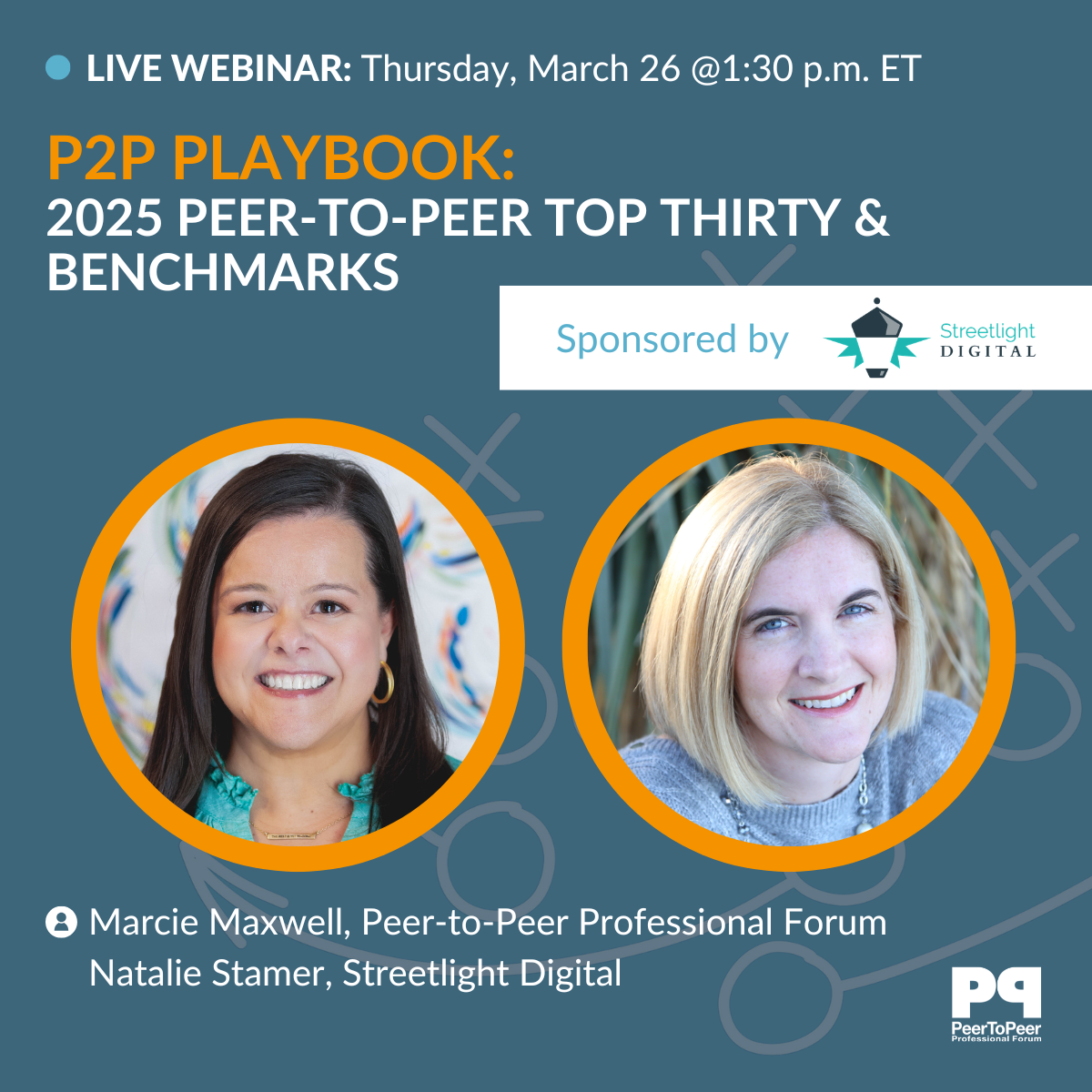
The P2P Playbook Webinar: Benchmarks, Trends, and Growth Strategies

Every strong peer-to-peer program has a game plan, but what’s working right now, and how can you apply those insights to your own program?

Join the Peer-to-Peer Professional Forum and Streetlight Digital for a 45-minute webinar exploring insights from the Top 30 U.S. and Canadian peer-to-peer programs, along with benchmark data from 150+ programs across the industry.

At P2PForum26, Natalie Stamer (Streetlight Co-Owner and Managing Partner) shared an early look at the Benchmarking Study and the trends shaping today’s P2P landscape. This webinar is a chance to go deeper into the data and unpack what it means for your program.

Even if you attended the session at P2PForum26, you’ll walk away with additional takeaways. And if you missed it, this is the perfect opportunity to catch up on some of the most valuable insights from the study.

While the analysis highlights the Top 30 programs, the lessons apply to organizations of all sizes. If you run a peer-to-peer program, these benchmarks can help you identify opportunities, refine your strategy, and set stronger goals for the year ahead.

March 26, 2026 | 1:30 p.m. ET

Bonus: All registrants will receive the U.S. & Canadian datasets from the study to use for their own benchmarking.

REGISTER TODAY! https://www.peertopeerforum.com/p2p-playbook-2025-p2p-top-thirty-benchmarks-webinar/